Abstract:
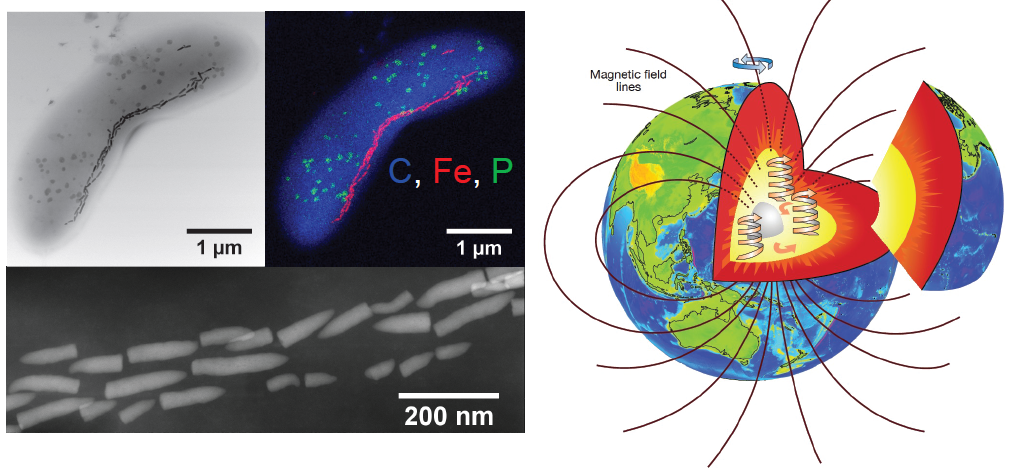
Magnetotactic bacteria (MTB) are diverse prokaryotes that biomineralize intracellularly perfect magnetite (Fe3O4), or less perfect greigite (Fe3S4), crystals. MTB are ubiquitous in modern aquatic environments. Their production of magnetically ideal nanomagnets means that their post-mortem remains (magnetofossils) can potentially provide a record of ancient life on Earth. MTB live within chemical gradients across the oxic-anoxic interface (OAI) in water columns and sediments. Their strong cellular magnetic moment enables MTB to navigate via magnetotaxis along geomagnetic field lines to reduce their search to one dimension to find ideal niches within chemically stratified aquatic OAI environments. However, sulphidic environments below an OAI will cause magnetite to dissolve. So, I expected for 20 years that, while MTB are interesting organisms, they will not be important in the geological record.
About 15 years ago, my views changed when we started to find widespread magnetofossil preservation in ancient sediments. By avoiding organic-rich sedimentary environments, it should be possible to develop a global magnetofossil record — but how far back could such a fossil record extend? Molecular clock evidence suggests that the genes that enable MTB to navigate along geomagnetic field lines evolved in the Archaean at 3.2-3.4 Ga. The recent explosion of magnetofossil reports is restricted mainly to the Cenozoic (0-66 Ma), with only a handful of older reports. We are now building a global magnetofossil record back in time to answer questions such as: how old are the oldest magnetofossils, can MTB tell us about the early evolution of our planetary magnetic field (which is argued to be an essential ingredient for the habitability of Earth), and can the hard mineralized remains of MTB provide a clear record of the first three billion years of life on Earth when life was dominantly unicellular? I will explore these questions in this talk.
Watch the live stream and the recording on Youtube.